Panelists: Dr. Chunyue Yin, Dr. Richard Thompson, Dr. Henkjan Verkade, Dr. Akihiro Asai
Questions and then I mean the goal is we can funnel to we have the coffee tables that you guys are all at later so maybe we can just focus on questions will be there later it might be easiest if you have a few questions in mind just to ask or let me or like just like a. Just like, you know, it’s gonna be hard for you. I know. I know that.
That’s OK. All right, so I’m gonna, let’s see, we’re gonna improvise a little bit. So we’ve only got about 10 minutes to chat amongst ourselves, to do some Q&A, but I know that there’s a lot of questions about research advancements and so there’s gonna be time later today, so we’re gonna have some of those questions. We gotta start the next session right at 2:25, so we only have 12 minutes, I mean I can challenge this panel to keep your answers to 60 seconds or less, but I know how that goes.
If we keep Richard off stage, I don’t know, maybe that’ll help, I know he’s already answering the questions, so 2:25, the next session’s gonna start. Are there any burning questions from this panel that you’re like, I have to know this now? You can have my seat. I’m, well, you’re late, so I’m just sitting here until you get here.
Do you wanna ask, do you wanna ask the questions? No, well, OK, I have a question. Well, I’m thinking of a question, so you. You have a question.
Olivia has a question. OK, you might be the only question. So is it, do you wanna come up on stage, Olivia, and ask a question? Olivia’s got a question.
Hello, I’m Olivia. I’ve been recently diag diagnosed with PFIC um after having ICP. Doctor Villarreno is doing the genome sequencing. Exome didn’t come back with anything.
What are her results going to say and do for, like, if she identifies something, how does it become one of those letters up there? That’s a very good question. Letters up there. Well, the truth is that there’s far more likelihood that it won’t be, OK.
It’s a minority, like 25% or something like that, of reasonably severe ICP have got mutations in these genes. And by far the most common is MDR3 and BSEP. But even then, at the moment, the majority don’t have mutations in the known genes. Now when she does the genome, I’m sure she’ll, well, when she does the genome, do you know how many variants she’ll find? How many, how many abnormal variants there are if you do a whole genome sequence.
Right. There’s 1 million variants. OK. OK.
So it’s, there’s a reasonable chance that one of those 1 million variants is contributing to it, but it may well be in a gene that we don’t understand yet or whatever. But let’s cross our fingers and it’s one of those, and then we can, you know, give you slightly more prediction, but statistically, the odds are against us at the moment. OK. Excellent, thank you.
Any other burning questions? We have a few minutes. I kinda have a question that’s for me, and I don’t know if I’m gonna answer it very well or ask it very well. Emily Perrito has a question, I guess.
All right, I’m gonna, I’m gonna bring it to you. No, I need time to formulate mine. It’s like stuck in my brain and doesn’t make sense yet. This is a question about sort of, the gene editing therapy or gene, Therapy going forward, you know, we know for the urea cycle disorders, they don’t really have intrinsic liver disease, but a lot of the PFIC patients already have intrinsic liver disease, and we worry about liver enzymes after the gene therapy.
Do you have a sense of how that’s gonna play out, or are patients who have liver disease, sort of, you know, AST ALT elevation or some cholestasis, how are people gonna feel about gene editing in them? So I think it’s um delivery is the key. So if you use a virus, it’s concerning because basically you are infecting the damaged liver. So the virus delivery is probably concern for the safety.
So that’s why majority of uh current genome editing uh strategy is using the messenger RNA in the lipid. Nanoparticle, which has much less, toxicity, fat, over, but it’s not an infection. For the liver disease who someone who has a substantial liver disease, the virus therapy, gene therapy using the virus is, probably concerning. So there’s, there’s a lot of strategies for gene editing and gene insertion because we didn’t, you heard this morning about AAV, you’ve heard about, base editing.
There’s actually a lot more technologies out there, and I think in the end, the technologies will evolve, but equally, there will be definite preferences for certain diseases and certain technologies for all sorts of reasons. First is safety, but there’s also efficacy and how efficient they are at doing it. And actually, What we’ve done, what happened with base editing is that you’ve got a relatively small number of cells are corrected. But for a urea cycle, you can have a high amount of enzyme in a small number of cells and get a reasonable correction of phenotype.
But actually there’s not really a great selective advantage in terms of corrected cells. The corrected cells are not actually much healthier than the non-corrected cells. But for BSEP deficiency, for instance, where the corrected cells will be much healthier, have a much higher advantage because they’re not poisoned by bile acids, then actually we could use a system where we actually correct a relatively small number of cells, but then we would expect repopulation of the liver. So actually BSEP is an attractive model from that point of view, but if you’ve got extensive fibrosis, then it’s gonna definitely make delivery worse.
And now one thing that I absolutely do not want to do, in any of our children is use AAV, which you’ve heard is, you know, works in the animal model, but first of all, it has got toxicity, and second, it doesn’t have persistence. So it’s fine in an animal, but all the AAV work that’s been done so far, it’s mainly in people that haven’t got liver disease, it’s been done in hemophilia, etc. But all those are time limited. They’re not gonna last, indefinitely.
And at the moment you can’t repeat dose with AAV and in fact it’s worse than that. In the current, the most recent AAV trial, 65% of the patients screened couldn’t even have it in the first place because they’ve already got antibodies before they started. But repeat dosing at the moment is not possible. But you know, if repeat dosing with AAV is possible, that might change things, but giving AAV to people with existing liver disease is definitely gonna be a limiting factor.
I have a question. Oh, sorry. No, so I’ll take mine and then I’m gonna go to you. We just have 5 minutes, so I’m gonna keep us on track time-wise, but, when you talk about some of these gene editing or gene therapies, what like age do you think these patients will be when you’re delivering? Are we talking about patients when they are first diagnosed or when they’re getting sicker and on liver transplant or after? I’m, I’m sure people will have the same question, I’m sure people will have different opinions on that, but I think the very first experiments will probably be done on people with quite severe liver disease, to be honest.
They’ll be done in patients who may well be listed for liver transplantation, and it may be in the first. First instances, we have to start with a low dose and it may not even be enough to correct the disease enough to stop them having a transplant. We may be lucky and it does, but you know, the initial testing will have to be done to, with a mind to safety and then trying to get some efficacy data. But so it may be that we’d actually do it on somebody who is inevitably gonna have a transplant and then they still carry on and have a transplant.
But we’re, you know, obviously once we, once it’s established and we know how to do it and we’ve done it in such patients, we will then start moving into what work we understand what the right sort of dose is, and we will try and deliver it to patients who are not inevitably heading to transplant. And obviously eventually, if all that goes to plan, eventually somewhere way down the line, we’ll be giving it to people who are maybe even asymptomatic, who’ve been diagnosed on core blood testing, who haven’t even got liver disease, but I’m afraid they’re not gonna be the first patients who receive this sort of therapy. Sorry, I didn’t, I didn’t let you ask it. OK, we just have 3 minutes.
I can take 1 more burning question. What is it? Is Ben’s got a question still. Is that, did he shake his head? My, oh, Ron’s got a question.
Ask him. He won’t go in 3 minutes, so it’ll take. In terms of, therapies, I haven’t heard anybody mention phenylbutyrate and other chaperones as potential therapies. I wondered, particularly since there’s genetics involved, if anybody up there wants to address that.
I met uh a colleague in Japan. They are wrapping up the clinical trial, so they will have a publication soon. With, 4 female butturate, yes, 4, so they walked up on the clinical trial for BSEP. And um the PI, I think the PFIC in general, in general, and it wasn’t they are genotype based and it was they are writing the manuscript right now I think we’ve tried it also in patients without success, I can say, but the difficulty is that I had to bring it back to the problem.
You can have a mutation by which the protein from the synthesis does not get to the membrane to be active. And phenylbutorate is then a drug that can correct the folding to some extent to get it still in the membrane. The problem is that we have many different variants and mutations among different patients, and ven but, we don’t know really on which of the mutants it does or does not work. So it’s a lot of trial and error so far.
And that makes it difficult to to really propagate this for all patients. Because probably in the end, it may work only for a few patients or a limited number of patients. And since we do not know which are susceptible or not or sensitive, that so far is still we are not smart enough as far as I know the literature to predict it really which does or does not react to it. Thank you, and I’m going to thank the panel.
Sorry, I know we want more time, but there will be time in the topic tables later this afternoon to further discuss these topics. So thank you very much for the presentation, Q and A.
2026
PFIC Research Advancements Part 2 (Panelist Q&A)
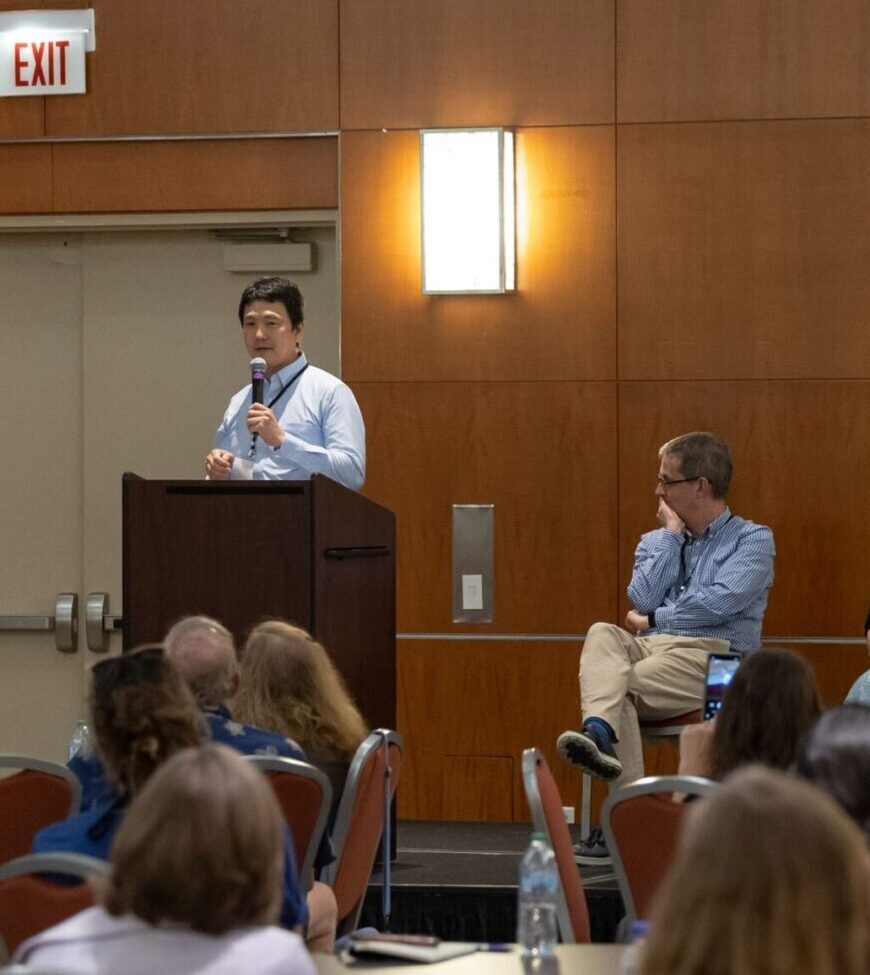
Following the PFIC Research Advancements panel, this open Q&A gives the audience a chance to dig deeper with our panel of researchers — covering topics like gene therapy trial timelines and eligibility, transplant considerations, and other emerging therapies.
Panelists:
🔹 Dr. Chunyue Yin, Cincinnati Children’s (moderator)
🔹 Dr. Richard Thompson, King’s College London
🔹 Dr. Henkjan Verkade, Beatrix Children’s Hospital (Netherlands)
🔹 Dr. Akihiro Asai, Cincinnati Children’s
This session was recorded at the 2026 PFIC Family & Scientific Conference in Chicago, IL.
For the full research presentations that preceded this discussion, watch our PFIC Research Advancements Part 1 recording.
Did you like this video?
Whether you’re newly diagnosed or years into your PFIC journey, our webinar library has something for you. Browse topics like genetics, treatment, transplant, and coping strategies, all in one place.