Erin’s Story: Living with ABCB4 Disease
Hey y’all. My name is Erin, and I am from Lake Park, Georgia, and I, have a heterozygous mutation on my ABCB4 gene. Does having that heterozygous mutation qualify as a stand-alone diagnosis for ABCB4 disease or MDR-3 deficiency, or genetic cholestasis or whatever you prefer to call it. I think a lot of people here would say yes, or yes if, and then add a qualifier or a modifier, like, yes, if you were symptomatic.
I am symptomatic. I have been since 2006, which is my entire adult life. Now that I know I have an ABCB4 mutation, my doctors can look back through that lens, and see a pattern of medical anomalies that are related to the mutation. I didn’t need a genetic test to tell me that these things, these medical anomalies were related.
For me, it was always a very clear pattern. For about the last 10 years, every time I would get in front of a doctor, I would start the conversation off with, when I was 19, and I would go on to describe every instance that I felt was related to ongoing and worsening symptoms. I just didn’t have a name for what was happening. And I have to do both things, right? So what do my symptoms look like? Because I did not have a diagnosis for so long, a lot of my symptoms were dismissed.
I have a history of what I was repeatedly told was medication allergies, specifically intense itch, which I now know is probably a sign that I was experiencing elevated LFTs. I’ve had my gallbladder removed during the middle of a very traumatic twelve-day hospital stay, which also included pancreatitis. I’ve had frequent episodes of what I call attacks, post gallbladder removal, which were each then followed by what I now know was probably cholestasis. I’d have a trigger event, usually an illness.
I’d have the attack, I’d go to the ER, I’d receive no follow-up. And then I’d be unwell for a while. I’d lose weight, my hair would fall out, I’d get really thin, I’d bruise easily. I’d be itchy as I stand here scratching.
I’d have a lot of pain and discomfort. These episodes never included jaundice, but I would get sort of pale and gray. Each of these episodes got progressively worse, and it would take me longer and longer to bounce back after each incidence. The last one was in 2023, did not bounce back.
I kept getting worse. After 9 months of worsening symptoms and blood work, I was put on 1500 mg a day of ursodiol. That was the only thing that brought my LFTs and GGT back into normal range, eventually. I began taking Urso 17 years after my first onset of symptoms.
A marked improvement in my blood work so soon after starting Urso was one of the indications that I potentially had a mutation on my ABCB4 gene. And it was one of the reasons my provider ordered genetic testing. I learned about my mutation by taking a genetic test sponsored by Prevention Genetics in March 2025. Took the scalp by Mirum cholestasis test, which at the time included 77 genes.
My provider at Shan’s ordered the test, Prevention Genetics, provided the lab report and a genetic counselor to interpret my results. I did a pre-test and a post-test interview over the phone with genetic counselor. However, The results were marked as non-diagnostic, with a note that the ABCB4 mutation could be an influence that may be modified by other factors. It was a few days after I talked to the genetic counselor before I could speak to my provider.
So I had time to dive into the research. And my conclusion during that process was that I did not agree that this was non-diagnostic. I am so lucky that I had a provider who listened to me and who took the test results and then dived into the lot of the same research I had. Partly because before ordering the test, I had already laid out the connections with my symptoms and my past medical history.
So when he started researching, he saw my pattern emerge. I have been to doctors who have dismissed me, my intuition, this case of symptoms I have built. But he didn’t. And at the age of 38, 19 years after my symptoms started, he diagnosed me.
He also encouraged my research. Anything I’ve brought to him in follow-up, he has supported 100%, including referrals. At the time of my genetic testing, Clin, specifically what the genetic counselor referred to in our discussions, showed my mutation as a variant of uncertain significance. It has since been updated to conflicting classifications.
Genomenon does list my specific mutation in their database as pathogenic. They’ve recently provided an entry for ClinVar, which I believe is why the update in ClinVar’s classification. Most importantly, there was a functional study performed with this mutation in the late 90s. And I want to highlight here the significance of this article.
It was the 4th mutation ever described in the literature. It showed the mutation resulted in a defect in the protein trafficking. The patient had ICP, so the defect is what caused the ICP is what their conclusion was. There has been a lot of follow-up articles showing that other variants also cause ICP, and this has led to the conclusion among the medical community that the heterozygous ABCB4 mutations can cause ICP.
But despite all that, this specific mutation still isn’t classified as pathogenic. And if I was not so lucky and had a different provider, that could have been a barrier to diagnosis for me. I have never been pregnant. I never will be, so I’ve never had the chance to have ICP.
Would that have changed the outcome of the genetic report if I had? I have no idea, but I think about that. Does not being pregnant. Provide a barrier to diagnosis for someone with this mutation.
As I dug into the research, I was able to see how the understanding of the ABCB4 gene developed over time from 2000 when this was published to now. So I did what any well-adjusted person would do, and I researched, I emailed the researchers. Doctor Katherine Williamson was the lead researcher on this project. Her main research focus is women’s health and ICP, not necessarily PFIC, but she works with hepatologists.
We had a great Zoom call, and I did start the conversation off with when I was 19. And she validated my case, my understanding of the research and how researchers now understand ABCB4 genes, mutations. 2.5 decades later, of course, she even wrote a letter to me for my providers with recommendations. A lot has happened between 2000 when my study, when this study about my mutation was published in 2025 when I got my genetic report.
That is most of my life. My entire adult life has been these frustrating cycles of illness, weakness, pain, dismissal about patterns that I was experiencing, uncertainty about my health and my future. I feel like gallbladder disease has this perception of it’s not dangerous, it’s easy to treat. But what happens when it’s not? It’s incredibly painful.
Still pass bile stones even on 1500 mg a day of urso. My last episode of biliary colic and subsequent biliary reflux was a month ago. I am still on a liquid diet. Obviously it was not as intense as previous flares, but it’s still painful and still scary.
Regardless of the label, I have 20 years of qualitative data in this lab, that is my body, that shows that I am symptomatic with something. More and more labs are classifying the ABCB4 gene as autosomal dominant instead of recessive. The NIH shows it as both depending on the mutation, and BA, now LabCorp, labels it as dominant and ClinVar labels it as recessive. So I’ll leave you with this question.
The question that even after all of my experiences, my research, my newfound understanding for my health, In a room full of experts. Does having a non-pathogenic heterozygous mutation on a recessive gene cause disease? Thank you. I know Doctor Thompson really wants to answer that question, but I’m gonna make you do it in the round tables because we’ll never get anywhere.
2026
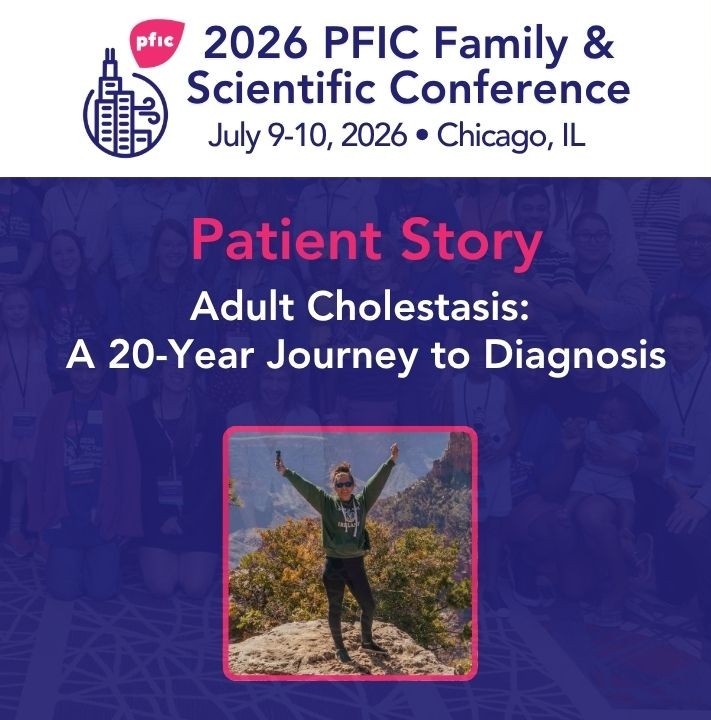
Adult Cholestasis: Erin’s Story of a 20-Year Journey to Diagnosis
Erin shares her deeply personal story of living with undiagnosed symptoms for nearly two decades before genetic testing revealed a heterozygous ABCB4 mutation. Her talk explores the real-world challenges of getting a diagnosis when your case doesn’t fit neatly into existing classifications, including navigating conflicting variant interpretations, gaps in genetic testing panels, and what it means to advocate for yourself when your intuition and your test results don’t initially agree.
This session was recorded at the 2026 PFIC Family & Scientific Conference in Chicago, IL.
Did you like this video?
Whether you’re newly diagnosed or years into your PFIC journey, our webinar library has something for you. Browse topics like genetics, treatment, transplant, and coping strategies, all in one place.