2024 PFIC Research Grant Results
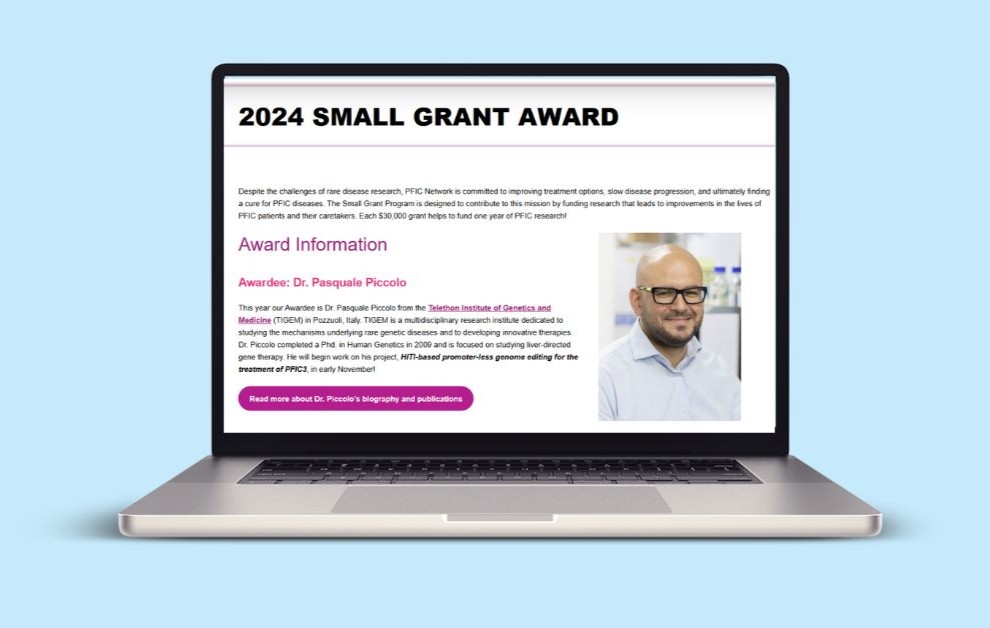
In 2024, our community-funded research grant was awarded to Dr. Pasquale Piccolo at the Telethon Institute of Genetics & Medicine in Italy.
His study, “HITI-based promoter-less genome editing for the treatment of PFIC3,” consisted of the first steps to investigate whether a new gene-editing method could potentially lead to a long-lasting treatment for PFIC3.
We are excited to share a lay summary of his project results below!
Progressive Familial Intrahepatic Cholestasis Type 3 (PFIC3) is a severe inherited liver disease caused by mutations in the ABCB4 genes. Mutations are changes in the code of a gene. ABCB4 makes a protein called MDR3 which moves a certain fat out of liver cells and into bile.
When MDR3 is not built correctly due to mutations in ABCB4, its function can be compromised, and harmful substances can build up in the liver. Over time, this buildup can cause scarring of the liver. Current treatments offer limited relief, and many people living with PFIC3 continue to see their health decline over time and eventually need a liver transplant.
This study tested a specific type of gene therapy with ABCB4. Standard gene therapy may deliver a functioning copy of ABCB4 to liver cells, but the effect can fade over time as the liver grows or repairs itself.
To overcome this limitation, the research team tried a different approach. They inserted a correct copy of the ABCB4 gene directly into the DNA of liver cells, at an exact spot called the “albumin locus”. This site is naturally very active in the liver, which can help the cell to produce large amounts of MDR3 protein.
Note: This work was done in a lab and in mice. It has not been tested in people yet.
Inserting a gene into DNA requires special tools, called gene-editing tools. The researchers first built and tested the necessary editing tools in the lab and then in mice. To show that the approach could work, they initially delivered both the gene-editing tools and the correct ABCB4 gene to liver cells using modified viruses. This proof-of-concept study produced encouraging results and provided the first evidence that the strategy could improve liver disease in mice.
The team is now developing a version of the treatment that uses lipid nanoparticles, tiny particles designed to deliver genetic material. This approach may offer a path that is more readily applicable to future studies in people. Ongoing research is focused on identifying the optimal dose and further improving the treatment.
Preliminary results look promising. Benefits include improvements regarding scarring of the liver and blood markers of liver injury especially in male mice, and to a somewhat lesser extent in female mice. The researchers also observed potentially improved results over time.
These results are not yet published. Be on the lookout for full results in 2027 if accepted for publication!
Overall, this project provides early evidence that targeted genome editing may be a promising strategy for PFIC3. The findings support further development of this approach and may also inform future therapies for other inherited liver diseases where long-lasting correction is needed.
Acknowledgement
This grant from our Small Research Grant program was made possible by community fundraising efforts. Awards were reviewed and assessed by our International PFIC Research & Registry Review Committee (IRRRC) and Expert Review committee, a group of trained volunteers and clinical/science advisors who govern many of our research programming efforts.
We thank both our volunteers and donors for making awards like this possible.